


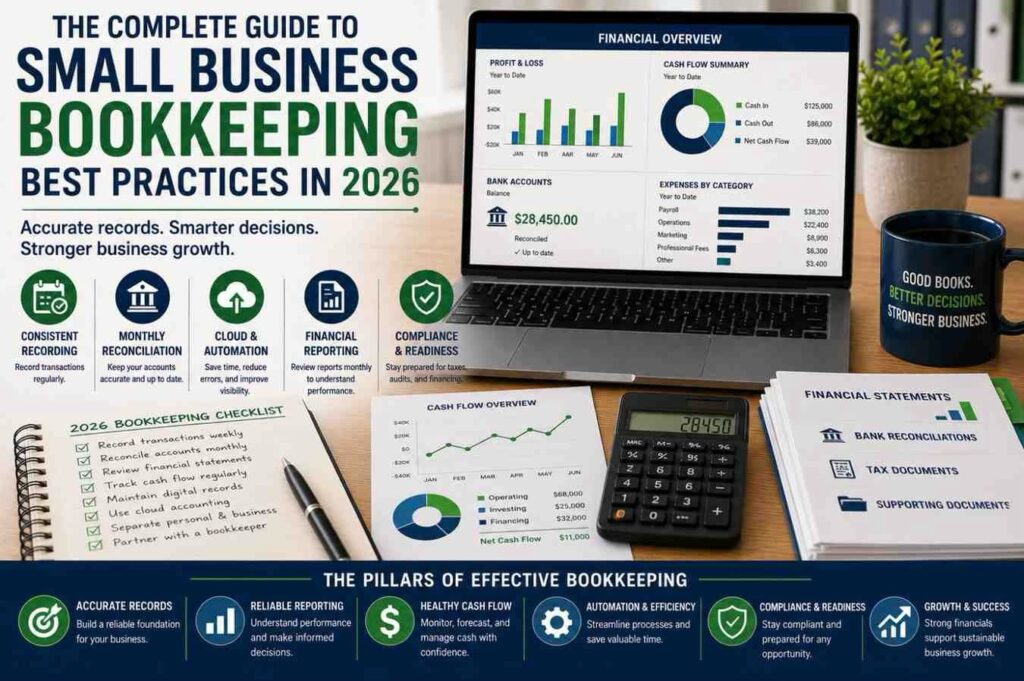
The Complete Guide to Small Business Bookkeeping Best Practices in 2026
Introduction
Working with permutations, the cryptography in question began during the economic revolution of 2026. Accurate documentation in this area helps the owners understand properly the profitability and also compliance, thereby giving some insightful confidence levels while making the decision.
Modern record keeping has progressed greatly because of the cloud, automation, and a steady review of financial proceedings all aimed in giving a genuine picture concerning business performance.
Actually, if basic bookkeeping practices should be followed, they will prevent most of the expensive damages and huge blunders that might easily be an impediment to the long-term growth of the business.
The usual insight would be bookkeeping in bits to be more valuable for the company than money sprees every time. So, records stay accurate and support better decisions monthly financial reviews.
Core Bookkeeping Best Practices
- Record your transactions consistently throughout the month
- Reconcile your bank and credit card accounts monthly.
- Keep personal and business finances separate.
- Review profit and loss, balance sheet, and cash flow reports each month.
- Keep digital documents organized.
- Use cloud-accounting software and get backups made.
Broad Understanding: Continuous bookkeeping sets are more valuable than massive attempts at bookkeeping once in a while. Maintain records accurate with monthly financial reviews, and have one at hand for better decisions.
Technology and Automation
Spend Cloud bookkeeping platforms that aim at improving collaboration and bring in account the moment it is earned.
Automation eases double entries despite improving consistency.
Get the business owner to do a review on a report that runs every other week. Accuracy is what sets benchmarks for any trends.
General Scope: Consistency is greater value than an occasional big time-consuming bookkeeping. Monthly financial reviews clarify the exact nature of the records and assist the decision-making process further.
Common Mistakes to Avoid
- Waiting till the tax season to update financial records.
- Not reconciliation possible
- Misclassifying some expenses.
- Sometimes, one might forget about cash flow reports.
- Non checking of financial statements, say, every month.
Broad Understanding: Continuous bookkeeping sets are more valuable than massive attempts at bookkeeping once in a while. Maintain records accurate with monthly financial reviews, and have one at hand for better decisions.
Content Angle: The Pillars of Effective Bookkeeping
The graph below illustrates the prime beneficiaries from strictly adhering to state of the art bookkeeping practices.
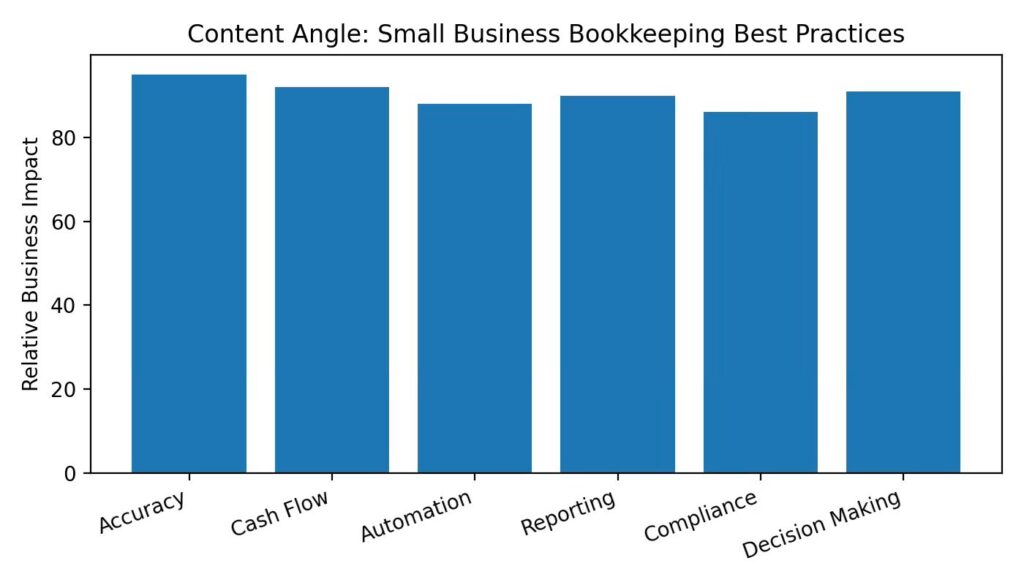
“Strengthening each component of a growing business is achieved by having accurate records, trustworthy reportage, cash flow, automation, compliance, and decision-making that is well informed. “
Expanded Insights
Monthly Financial Reviews
Review key financial ladies each month to spot trends, track expenses, and keep ahead of changing business conditions before they become critical.
Step: Calendarize monthly bookkeeping review, regular updating of financial records, and seek insights in financial reports which will direct future business decisions.
Cloud Accounting
Business people have secured access to financial data with the help of cloud-based software for bookkeeping and also improved cooperation between accountants and documented record-keeping procedures.
Step: Create a recurring monthly bookkeeping review event, repeatedly update financial records promptly and shall thereby use its insights for future business decisions.
Internal Controls
validate endorsement processes, pacify reconciled accounts and engage maintenance of adequate supportive docume ntation in avoidance of fraud risks and enhancement of accurateness in reporting.
Action Step: Plot a regular monthly Review of your Books. Update those financials followed by insights gathered from reporting to steer one’s future-business related decisions.
Preparing for Growth
The right bookkeeping will make hiring, obtaining financing, expanding, and preparing for tax or audit a whole lot easier.
Action Step: Plot a regular monthly Review of your Books. Update those financials followed by insights gathered from reporting to steer one’s future-business related decisions.
2026 Bookkeeping Best Practices Checklist
- Record transactions weekly.
- Reconcile all accounts monthly.
- Review financial statements every month.
- Track cash flow consistently.
- Maintain digital records and backups.
- Separate personal and business finances.
- Use cloud accounting software.
- Partner with a professional bookkeeper.
Suggested Internal Links
Authority Sources
- https://www.irs.gov/businesses/small-businesses-self-employed
- https://quickbooks.intuit.com
- https://www.sba.gov
FAQ
What in your opinion is the most beneficial bookkeeping habit?
To keep my records up-to-date by entering the transaction usually and reconciling it monthly.
Should the cloud bookkeeping tool be used for small businesses?
Yeah, it will. Through use of cloud-based bookkeeping software, a small business can be more accessible, collaborative, and even error-free in bookkeeping and reporting.
How often should financial statements be reviewed?
At once a month to track the performance and make some decisions about how you should run your business going forward.
Call for action
Maikai Bookkeeping Services help small-scale ventures in adapting to the latest authorizations in professional accounting: accuracy records to ensure performance and keep it accurate, monthly reporting, cloud bookkeeping support, and even more advanced financial tips because we are proactive. Contact us for a stronger foundation of finances today.