
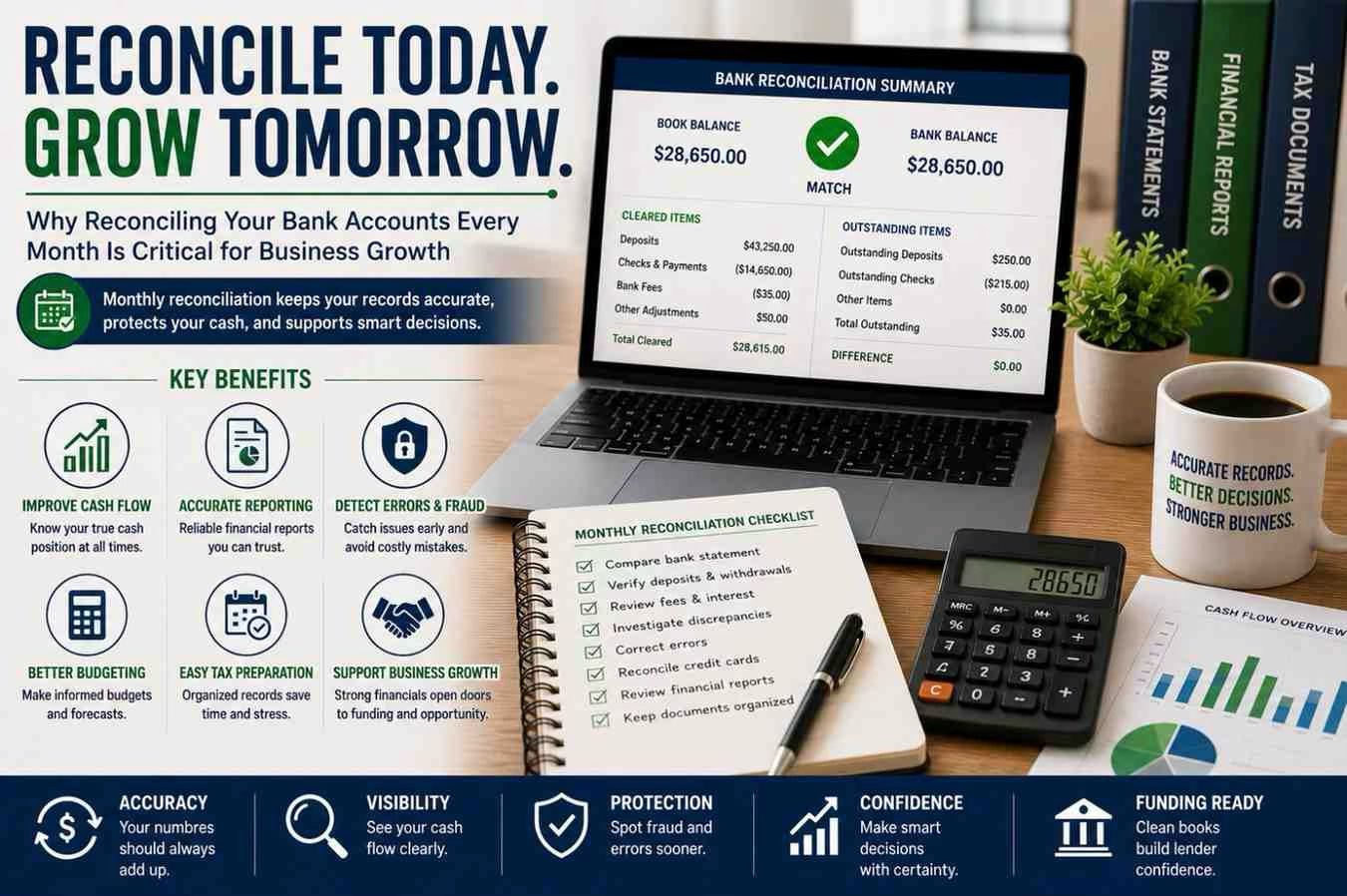

Why Reconciling Your Bank Accounts Every Month Is Critical for Business Growth
Introduction
One of the most important bookkeeping habits for owners of any small firm is reconciling bank accounts every month.
It’s the way that assures that what’s in the books also matches the bank activity, which in turn helps in catching before they become bigger problems errors, any missing transactions, duplicate payments, and fraud.
Consistent reconciliations result in precise financial information necessary for making sound business decisions and maintaining growth.
Food for thought, though, reconciling accounts on a regular basis helps ensure that an enterprise’s financial records are most current, rather than allowing little discrepancies to build into costly problems.
Why It Matters: Monthly Reconciliation
Bank reconciliations authenticate the correctness of every deposit, payment, transferring, and feast ing.
These reduce the errors in reporting, as the entire financial statements are quite trustworthy.
If business owners can see that their bank accounts are positive, their confidence level while checking cash flows, profitability, and operating expenses will increase.
Implementation Tip: By reconciling accounts on a schedule-every month- you keep the financial health of your records up-to-date and prevent anomalies from turning into a business-impacting situation.
Business Benefit
Stronger cash flow visibility.
More accurate financial reporting.
Quicker fraud or accounting-error detection.
Enhanced budgeting and forecasting.
Prepared even better in advance for tax season and financing.
Implementation Tip: By reconciling accounts on a schedule-every month- you keep the financial health of your records up-to-date and prevent anomalies from turning into a business-impacting situation.
Common Reconciliation Mistakes
Failure to initiate monthly reconciliations at all.
Overlooking certain bank service charges.
Letting transactions stay uncategorized.
Ignoring any discrepancies.
Waiting until year’s end before doing an overall review.
Implementation Tip: By reconciling accounts on a schedule-every month- you keep the financial health of your records up-to-date and prevent anomalies from turning into a business-impacting situation.
Content Angle: Why Bank Reconciliation Matters
The data below highlights what specific areas in your type of company benefit most from consistently doing bank reconciliations on a monthly basis.
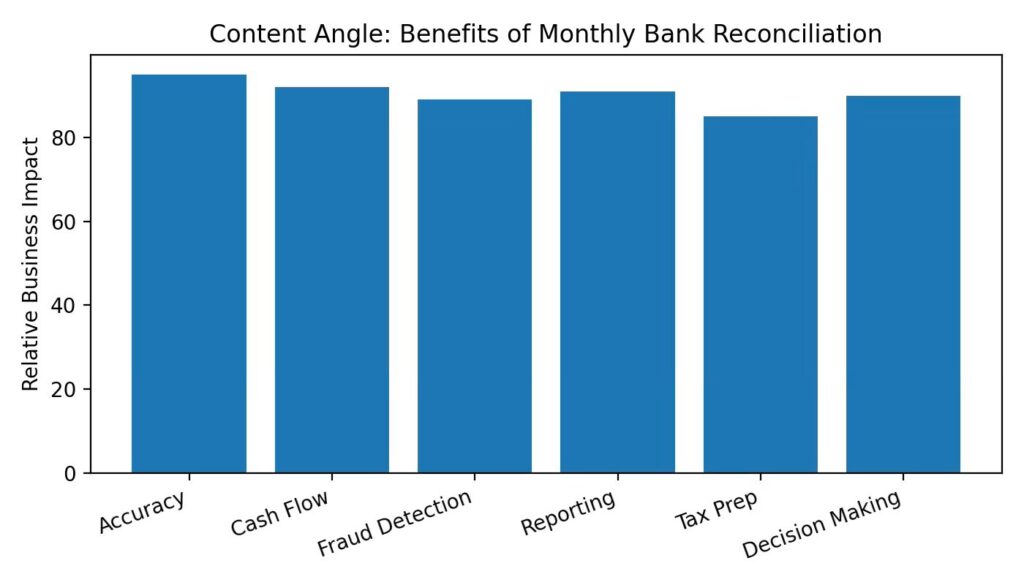
Editorial insight: Doing full, timely and regular reconciliations creates more precision in financials, improves the management of cash flows, detects issues earlier and, finally, supports knowledge-driven business decisions.
Expanded Insight
Visibility in Cash Flow
The reconciliation of bank accounts would ensure that the reporting cash balance is an accurate reflection of the reality so that the business owners can proceed to commit to procurements, payroll, and investments.
Action step: Schedule a monthly re-occurring reconciliation, every discrepancy should be reviewed immediately, and all adjustments clearly documented.
Error Detection
Reconciliation of bank activity every month will make it easier to find double data entry errors, deposit not deposited, and wrong charges, besides bookkeeping errors.
Action step: Schedule a recurrent monthly reconciliation, review each discrepancy right after, and document all adjustments clearly.
Reporting Penalties
Reliable reconciliation provides accurate profit and loss and balance sheets, and cash flow reports, all for the stakeholders and accountants.
Action Your Step Is: You should schedule, validate monthly, and instantly settle every difference and document any changes throughout.
Growing Business Growth:
Growing business requires consistent, accurate financial details when it comes to hiring employees, expanding the business, and acquiring finances.
Action Your Step Is: You should Schedule, validate monthly, and solve immediately and document any changes.
Monthly Reconciliation Checklist
- Compare bank statements with accounting records.
- Verify deposits and withdrawals.
- Review bank fees and interest.
- Investigate unmatched transactions.
- Correct bookkeeping errors promptly.
- Reconcile credit card accounts.
- Review financial statements after reconciliation.
- Keep supporting documents organized.
Suggested Internal Links
Authority Sources
- https://www.irs.gov/businesses/small-businesses-self-employed
- https://quickbooks.intuit.com
- https://www.sba.gov
FAQ
How often does a business needed to reconcile their bank account?
An average firm should ideally re-balance all bank accounts and credit cards at least once every month.
What occurs when it is skipped-over in terms of reconciliation?
Errors grow, which leads to inconveniently slow cash flow and unreliable financial statements.
Can bookkeeping along with reconciliations be handled professionally?
Yes, professional bookkeepers are able to reconcile accounts with accuracy and create reliable financial statements, after that.
Call to Action
Maikai Bookkeeping Services get its clients in ensuring accuracy in books of accounts through timely bank reconciliation, monthly reports, and proactive bookkeeping assistance. Contact us now for your business finances to be organized while growing.