

How clean financial records can improve cash-flow visibility, tax readiness, profitability, planning, and smarter decisions for the year ahead
Year end is more than a tax deadline on the horizon. It is a decision point. Business owners need to know what the company earned, what it spent, what customers still owe, what bills remain unpaid, how much cash is truly available, and which parts of the business are producing healthy returns.
Accurate bookkeeping creates that visibility. When financial records are current and reconciled, owners can evaluate performance with greater confidence and enter the next year with a clearer plan. When the books are incomplete or months behind, even basic decisions about hiring, pricing, purchasing, taxes, and growth can become guesswork.
The IRS emphasizes that good records help businesses monitor progress, prepare financial statements, identify income, track deductible expenses, prepare tax returns, and support amounts reported on those returns. For business owners, those same records are also the foundation for better management throughout the year.
What Accurate Bookkeeping Really Means
Accurate bookkeeping is the consistent recording, classification, reconciliation, and organization of financial transactions so the books reflect what actually happened in the business.
A reliable bookkeeping process typically includes:
- Recording income and expenses.
- Categorizing transactions correctly.
- Reconciling bank and credit-card accounts.
- Tracking accounts receivable.
- Tracking accounts payable.
- Recording payroll-related transactions.
- Maintaining supporting documents.
- Reviewing financial reports for unusual balances or errors.
Accuracy is not the same as perfection. Businesses will sometimes need corrections, reclassifications, or additional documentation. The goal is to identify those issues promptly rather than allowing them to accumulate until year end.
Why Year End Makes Bookkeeping More Important
As the year closes, incomplete books can create a chain of problems. Missing expenses can distort profit. Unrecorded income can create reporting problems. Unreconciled accounts can hide duplicate transactions or unexplained differences. Old receivables can make revenue look stronger than the cash position really is.
Cleaning the books before the final weeks of the year gives owners time to investigate discrepancies while transactions, invoices, and business decisions are still relatively fresh.
Accurate Books Show Whether the Business Is Actually Growing
Revenue growth can be encouraging, but revenue alone does not tell the full story. A company can sell more and still become less profitable if labor, materials, advertising, software, financing, or overhead rise faster than sales.
Accurate records help owners compare:
- Revenue by period.
- Gross profit.
- Operating expenses.
- Net income.
- Cash balances.
- Accounts receivable.
- Accounts payable.
- Debt and other liabilities.
This creates a more complete picture of whether growth is financially sustainable.
Bookkeeping Supports Better Financial Statements
The IRS notes that good records are needed to prepare accurate financial statements, including income statements and balance sheets. These reports are not only for accountants or lenders. They are management tools.
Profit and loss statement
The profit and loss statement summarizes revenue and expenses over a period and helps show whether operations generated a profit or loss.
Balance sheet
The balance sheet provides a snapshot of assets, liabilities, and equity at a point in time. The Small Business Administration describes the balance sheet as a foundation for managing business finances and future cash-flow planning.
Cash-flow information
Cash-flow reporting helps explain how money moved through the business. Profit and cash are related, but they are not identical. A profitable company can still experience cash pressure when customers pay slowly or major expenses are due before receipts arrive.
Cash Flow Becomes Easier to Manage
Business growth usually requires cash before it creates cash. New employees, equipment, inventory, advertising, deposits, insurance, software, and other investments may need to be paid before the resulting revenue is collected.
Current books help owners understand how much cash is available and which obligations are approaching.
Useful questions include:
- How much cash is available today?
- Which customers still owe us money?
- Which bills are due soon?
- Are there recurring expenses we no longer need?
- Is payroll comfortably covered?
- Are seasonal slow periods approaching?
- Can the business afford a planned investment?
Accounts Receivable Deserves Attention Before Year End
An invoice recorded as revenue does not necessarily mean the money has been collected. A growing accounts-receivable balance can create a misleading sense of financial strength if customers are paying slowly.
Review receivables for:
- Past-due invoices.
- Customers with repeated late payments.
- Credits that were never applied.
- Duplicate invoices.
- Disputed balances.
- Invoices that may require follow-up.
- Potentially uncollectible balances that should be discussed with the appropriate accounting or tax professional.
Following up before year end can improve cash availability and create a cleaner starting point for the next year.
Review Accounts Payable
Accounts payable shows what the business owes vendors and other parties. Outdated or inaccurate payables can distort the balance sheet and cash forecast.
Check for:
- Bills entered twice.
- Payments not applied to bills.
- Old vendor balances.
- Missing bills.
- Upcoming large obligations.
- Vendor credits.
- Recurring charges that should be canceled or reviewed.
Bank Reconciliation Is a Core Accuracy Check
Bank reconciliation compares the accounting records with the bank statement and investigates differences.
Reconciliation can help identify:
- Missing transactions.
- Duplicate entries.
- Bank fees.
- Interest.
- Deposits recorded incorrectly.
- Checks or payments that have not cleared.
- Transactions posted to the wrong account.
A bank balance that looks reasonable is not enough. The accounting records and supporting bank activity should be reconciled consistently.
Reconcile Credit Cards and Other Financial Accounts
Credit-card accounts, payment processors, loans, and other financial accounts also need review. A transaction may appear in more than one system, and transfers can easily be categorized incorrectly.
Regular reconciliation makes year-end cleanup more manageable and reduces the chance that months of errors need to be reconstructed at once.
Separate Business and Personal Activity
Mixing business and personal transactions creates unnecessary bookkeeping complexity and can make financial reports harder to interpret.
IRS Publication 583 advises business owners to keep the business checking account separate from the personal checking account. A dedicated business account creates a clearer trail for income and expenses and makes routine bookkeeping more efficient.
Organized Supporting Documents Matter
Invoices, receipts, bills, deposit records, canceled checks, payroll records, and other supporting documents provide evidence for the entries in the books.
The IRS states that supporting documents are important because they support entries in business books and tax returns. Organizing them by year and type of income or expense can make retrieval easier.
A year-end document review can include:
- Sales invoices.
- Vendor bills.
- Receipts.
- Bank statements.
- Credit-card statements.
- Loan statements.
- Payroll reports.
- Asset purchase documents.
- Insurance documents.
- Relevant tax forms.
Accurate Bookkeeping Makes Tax Preparation More Efficient
Bookkeeping and tax preparation are different functions, but tax preparation depends heavily on accurate records.
When books are organized before tax season, the tax professional can spend less time asking basic questions about missing transactions and more time reviewing the information that actually requires professional tax judgment.
Clean records can help with:
- Identifying income.
- Tracking potentially deductible business expenses.
- Supporting amounts reported on returns.
- Organizing asset information.
- Preparing financial statements.
- Responding to questions from a tax professional.
Tax treatment depends on the facts and current law. Bookkeepers should not guess at complex tax positions that require a qualified tax professional.
Record Retention Is Not One-Size-Fits-All
The IRS states that records supporting income, deductions, or credits generally need to be kept until the applicable period of limitations expires, and some records require longer retention. Employment tax records generally must be kept for at least four years after the tax becomes due or is paid, whichever is later.
Businesses should use current IRS guidance and professional advice for their specific retention requirements rather than assuming every document can be discarded after the same number of years.
Bookkeeping Helps Identify Deductible Expenses
Expenses can be forgotten when they are not recorded as they occur. Accurate bookkeeping creates a consistent process for capturing legitimate business costs and preserving the supporting documentation needed for tax preparation.
The bookkeeper organizes and categorizes the information. The appropriate tax professional determines how specific items should be treated on a return when tax judgment is required.
Accurate Books Improve Budgeting
A budget is more useful when it begins with reliable historical information.
Year-end bookkeeping can help answer:
- What did we actually spend this year?
- Which costs increased?
- Which expenses are fixed?
- Which costs move with sales?
- What seasonal patterns appeared?
- Which investments produced measurable value?
These answers make next-year budgets more realistic than estimates built from memory.
Bookkeeping Supports Better Forecasting
Forecasting looks forward, but the assumptions should be grounded in what the business has already experienced.
Historical books can inform assumptions about:
- Monthly revenue patterns.
- Payroll.
- Rent.
- Software.
- Marketing.
- Inventory.
- Contractors.
- Debt payments.
- Seasonality.
Forecasts will never be perfectly accurate, but clean historical data gives management a more defensible starting point.
Understand Profitability by Service or Product
Total revenue can hide important differences between business lines. One service may produce strong margins while another consumes excessive labor or support time.
When the accounting system and operational data are structured appropriately, owners can begin comparing revenue and costs across meaningful segments.
Potential segments include:
- Service line.
- Product category.
- Location.
- Department.
- Customer type.
- Project.
- Sales channel.
Accurate Records Can Improve Pricing Decisions
Pricing decisions should consider the real cost of delivering the product or service. If expenses are misclassified or missing, management may underestimate the amount required to produce a healthy margin.
Clean books help provide a more accurate cost picture, although pricing should also consider market conditions, capacity, customer value, and competitive positioning.
Know the Difference Between Revenue, Profit, and Cash
Revenue
Revenue is the income generated by business activity under the accounting method used by the company.
Profit
Profit is what remains after applicable expenses are deducted from revenue for the period.
Cash
Cash is the money available in bank and cash accounts at a point in time.
A company can report profit while having limited cash because money may be tied up in receivables, inventory, debt payments, or other uses. Accurate bookkeeping helps management see these differences.
Bookkeeping Can Reveal Expense Creep
Recurring expenses can accumulate quietly. Software subscriptions, service contracts, merchant fees, advertising tools, storage, memberships, and other charges may continue even after their value declines.
Before year end, review recurring expenses for:
- Duplicate tools.
- Unused subscriptions.
- Price increases.
- Services no longer needed.
- Unexpected bank or merchant fees.
- Contracts approaching renewal.
Payroll Records Need to Be Clean
Payroll affects employee compensation, tax reporting, cash flow, and financial statements. Payroll records should be reconciled with the accounting system and reviewed for unusual balances or missing entries.
Businesses should also retain required employment tax records in accordance with current federal and applicable state requirements.
Review Owner Transactions
Owner contributions, draws, distributions, reimbursements, and personal expenses paid by the business should be categorized correctly based on the business structure and professional guidance.
Misclassifying owner activity can distort both the income statement and balance sheet.
Review Fixed Assets
Equipment, vehicles, furniture, technology, and other significant purchases may require asset tracking rather than ordinary expense treatment.
The IRS notes that businesses need records relating to assets to support information such as acquisition, cost, improvements, depreciation, and disposition. Tax treatment should be reviewed by the appropriate tax professional.
Review Loans and Liabilities
Loan payments often include both principal and interest. Recording the entire payment as an expense can produce inaccurate financial statements.
Year-end review should compare loan balances in the books with lender statements and investigate differences.
Inventory Businesses Need Additional Discipline
Businesses that buy, produce, or sell inventory may have additional accounting and tax considerations. Inaccurate inventory information can affect cost of goods sold, margins, and financial reporting.
Inventory procedures should match the company’s accounting method, operations, and applicable tax requirements.
Clean Books Help With Financing Conversations
Banks, lenders, investors, landlords, and other financial partners may request financial statements or supporting information.
Accurate books make it easier to provide consistent reports and explain the company’s financial position. The IRS specifically notes that financial statements can help businesses when dealing with banks or creditors.
Bookkeeping Supports Strategic Decisions
Business owners make decisions throughout the year about hiring, expansion, equipment, marketing, pricing, financing, and new services.
Those decisions become more informed when management has timely financial information rather than waiting until tax season to discover how the previous year performed.
Growth Can Make Weak Bookkeeping More Expensive
A simple bookkeeping process may seem adequate when a business has few transactions. As the company grows, transaction volume, payroll, credit cards, payment processors, locations, vendors, and reporting needs can multiply.
A weak system that was manageable at a smaller scale can become a significant operational problem after growth accelerates.
Year-End Cleanup Should Not Replace Monthly Bookkeeping
A large annual cleanup can be necessary when books have fallen behind, but it should not be the normal operating model.
Monthly bookkeeping spreads the workload across the year and allows problems to be identified sooner.
A monthly close may include:
- Recording remaining transactions.
- Reconciling accounts.
- Reviewing receivables and payables.
- Checking unusual balances.
- Reviewing financial reports.
- Documenting open questions.
Signs Your Books May Need Cleanup
- Bank accounts have not been reconciled recently.
- The books contain large Uncategorized or Ask My Accountant balances.
- Accounts receivable does not match customer records.
- Old unpaid bills remain open even though they were paid.
- Loan balances do not match statements.
- Personal and business expenses are mixed.
- Financial statements change significantly after year-end adjustments.
- The owner does not trust the profit and loss statement.
A Practical Year-End Bookkeeping Checklist
Reconcile accounts
- Bank accounts.
- Credit cards.
- Payment processors.
- Loans and lines of credit.
Review income
- Confirm sales and deposits are recorded.
- Investigate uncategorized deposits.
- Review accounts receivable.
Review expenses
- Record missing bills and expenses.
- Review recurring charges.
- Collect supporting documents.
- Investigate unusual categories.
Review the balance sheet
- Cash.
- Receivables.
- Payables.
- Assets.
- Loans.
- Credit cards.
- Owner equity accounts.
Prepare for tax coordination
- Organize supporting records.
- Prepare questions for the tax professional.
- Identify unusual transactions.
- Confirm access to required reports and documents.
Questions to Ask Before the Year Closes
- Are all bank and credit-card accounts reconciled?
- Are there missing or duplicate transactions?
- Which customers owe us money?
- Which vendor bills are outstanding?
- Does the profit and loss statement make sense?
- Does the balance sheet contain old or unusual balances?
- Are owner transactions categorized correctly?
- Are loan balances accurate?
- Are important receipts and invoices organized?
- What does the current year tell us about next year’s budget?
What a Bookkeeper Can Help With
The exact scope depends on the engagement, but professional bookkeeping support may include transaction categorization, reconciliations, accounts receivable and payable support, cleanup, reporting, document organization, and coordination with the business owner and tax professional.
The goal is not merely to enter transactions. It is to create dependable financial records that management can use.
Bookkeeping, Accounting, and Tax Work Are Related but Different
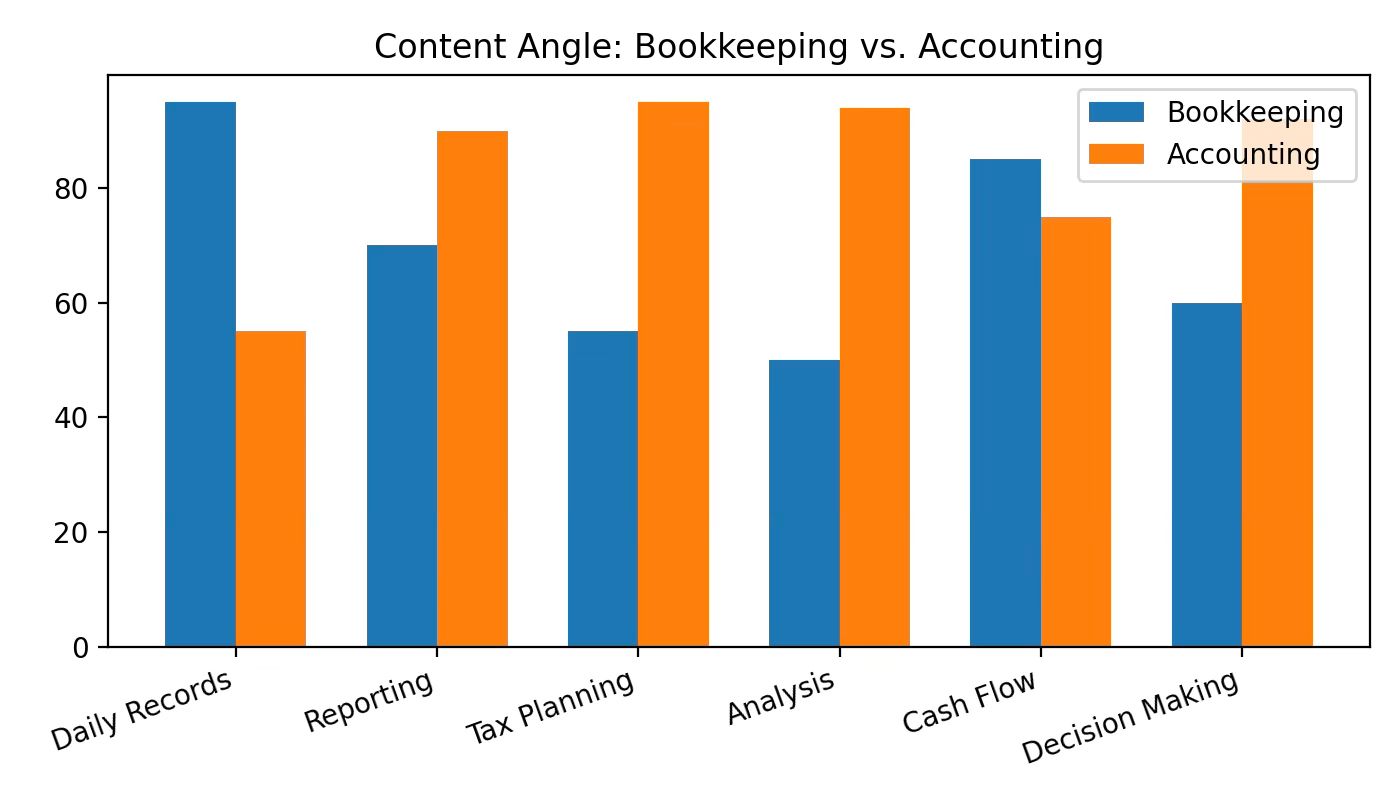
Bookkeeping focuses on maintaining the financial records. Accounting can include higher-level financial analysis, reporting, and technical accounting work. Tax professionals apply tax law to returns, planning, and tax-specific questions.
A strong financial process often requires these roles to coordinate while remaining clear about who is responsible for each decision.
Frequently Asked Questions
Why is accurate bookkeeping important before year end?
It gives business owners time to reconcile accounts, correct errors, review receivables and payables, organize supporting documents, understand profitability, and prepare cleaner information for tax and planning conversations.
Can a profitable business still have cash-flow problems?
Yes. Profit is not the same as cash. Money can be tied up in unpaid customer invoices, inventory, loan payments, or other uses even when the income statement shows a profit.
How often should bank accounts be reconciled?
Many businesses benefit from monthly reconciliation, while higher-volume businesses may review activity more frequently. The appropriate schedule depends on transaction volume and operational needs.
Does bookkeeping help with taxes?
Accurate bookkeeping provides organized records of income, expenses, assets, and other transactions that support tax preparation. Specific tax treatment should be determined by a qualified tax professional.
How long should business records be kept?
Retention periods vary by the type of record and the event it supports. Current IRS guidance should be consulted, and some records, including employment tax records and property-related records, can require longer retention.
Should business and personal transactions be separate?
Yes. Separate business accounts generally make bookkeeping clearer and reduce the time needed to distinguish business activity from personal activity.
What is bookkeeping cleanup?
Cleanup is the process of correcting and organizing books that are incomplete, unreconciled, or inaccurate. It can include reconciling accounts, correcting categories, addressing duplicate or missing entries, and reviewing balance-sheet accounts.
When should a business hire bookkeeping help?
Consider professional support when bookkeeping is consistently behind, financial reports are unreliable, transaction volume has grown, reconciliations are not being completed, or the owner is spending excessive time maintaining the books instead of running the business.
Accurate Bookkeeping Creates a Stronger Starting Point for Growth
Growth requires decisions, and good decisions require reliable information. Accurate bookkeeping helps owners understand where the business stands before they commit more money, people, or time to the next stage.
Before year end, clean books can reveal cash-flow pressure, overdue receivables, unnecessary expenses, reporting errors, and profitability trends while there is still time to act. They also make tax preparation and next-year planning more organized.
The goal is not simply to close the books. It is to begin the next year with financial information the business can trust.
Prepare for Year End With Maikai Bookkeeping Services
Maikai Bookkeeping Services helps business owners organize and maintain financial records so they can spend less time sorting through transactions and more time understanding their business. Depending on your needs, bookkeeping support can help with ongoing record maintenance, reconciliations, cleanup, financial reporting, and year-end readiness.
If your books are behind, unreconciled, or difficult to understand, addressing them before year end can create a cleaner handoff to your tax professional and a stronger financial foundation for the year ahead.