

Cash Flow Management Tips Every Small Business Should Follow
Introduction
Every small business is dependent on cash flow to sustain it. Financially successful companies need to manage cash effectively for them to alleviate the threats which might snatch.
Early understanding of the source of income, where the money goes, and when bills are due aids the owner in making wise decisions.
Around the clock, an eye on the books as well as more accurate financial statements maintains good visibility that is the requirement for stable cash flow.
The Ease Factor: Often, improvements in small-scale things, like invoicing, expense management, and financial reporting, are likely to make a massive difference in long-run cash flows.
Why Cash Flow Is Crucial
Positive current cash flows suppose that bills, wages, suppliers, and operating expenses can be paid on time.
Provides one the invincibility to invest in new opportunities and meet unforeseen costs.
Resilient in economic downturns basic business characteristics in a business that maintain good are associated with a strong cash-flow situation.
Within the span of an hour, it is surprising that very subtle modifications in invoice management, cost control, and financial reporting often lead to major long-term impacts on cash flows.
Practical Tips for Improved Cash Flow Management
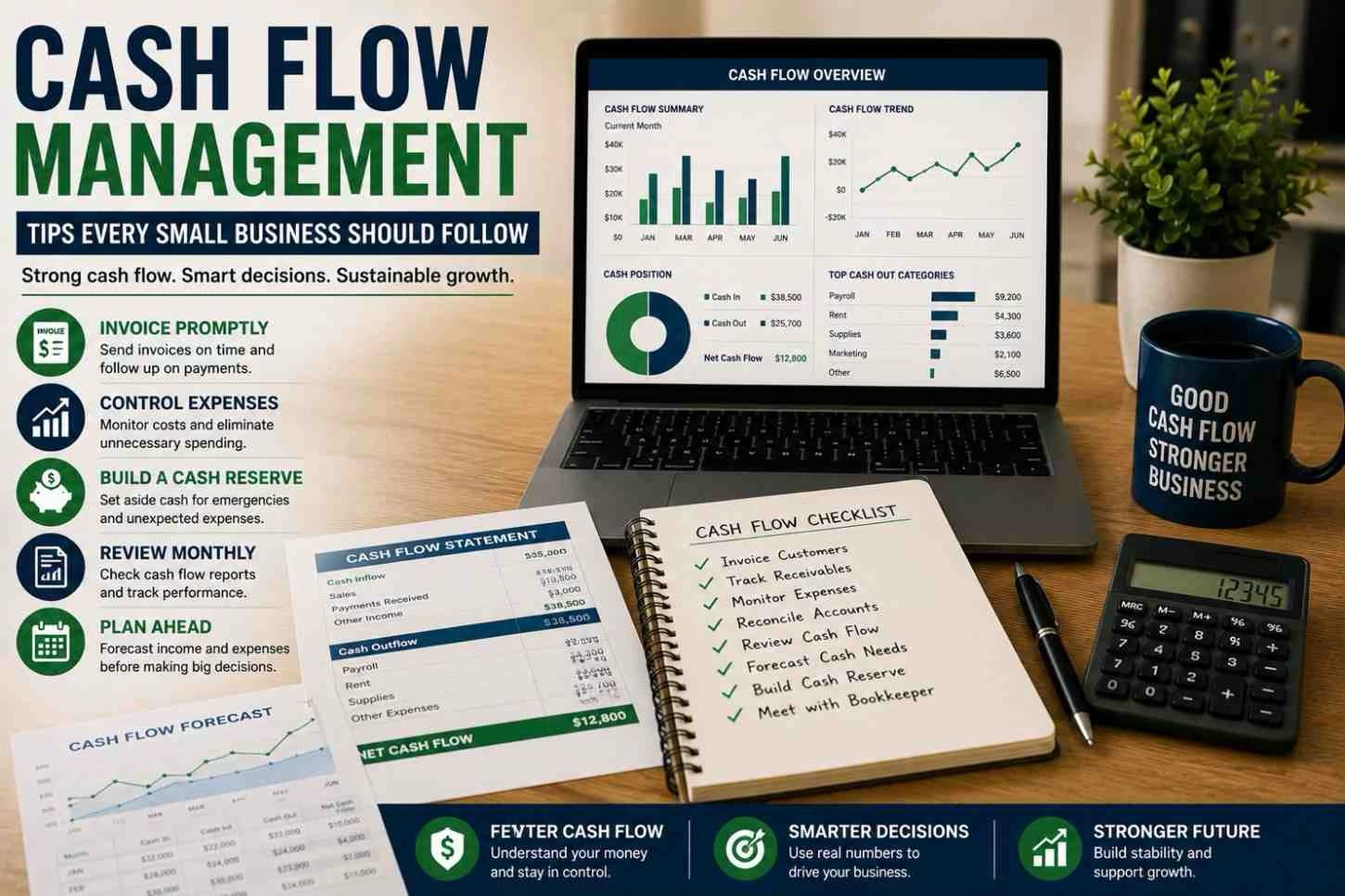
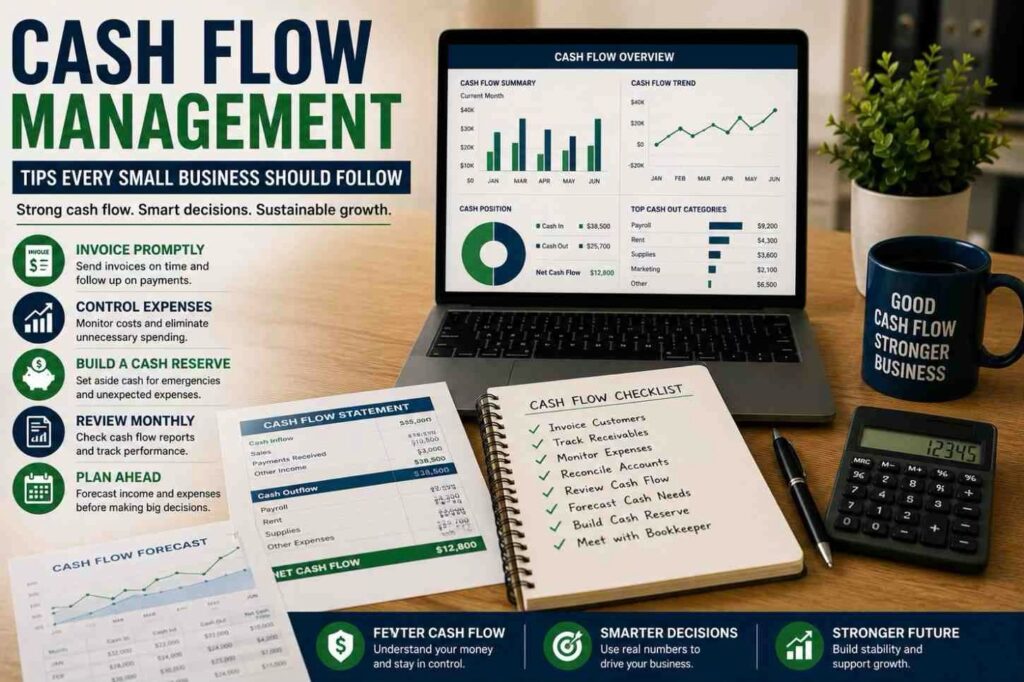
- Issue invoices to be paid and follow up on bills as necessary.
- Check and reduce expenses by eliminating all unnecessary costs.
- Have a reserve of cash readily available for emergencies.
- Go through reports so you will at least know what’s happening to cash monthly.
- Need to see in advance to project if new cash is around or finding funds out to keep the business going.
Such leading insight: It is often the small-scale improvements in the operations of invoicing, expense management, and financial reporting that result in substantial impacts over the long term.
5 Most Common Cash Flow Mistakes
- Waiting too long to express your worth via the invoice.
- Spending money excessively on money-rich months.
- Ignoring the regular flows through most of the business activities.
- Not foreseeing the seasonal features, their corresponding expenses, and sales.
- Review financial statements in an untimely manner.
Such leading insight: It is often the small-scale improvements in the operations of invoicing, expense management, and financial reporting that result in substantial impacts over the long term.
Content Angle: Building Strong Cash Flow
The following diagram gives an impression of how one might best manage the whole check in all essential aspects of the business activity-materially different than stated above.
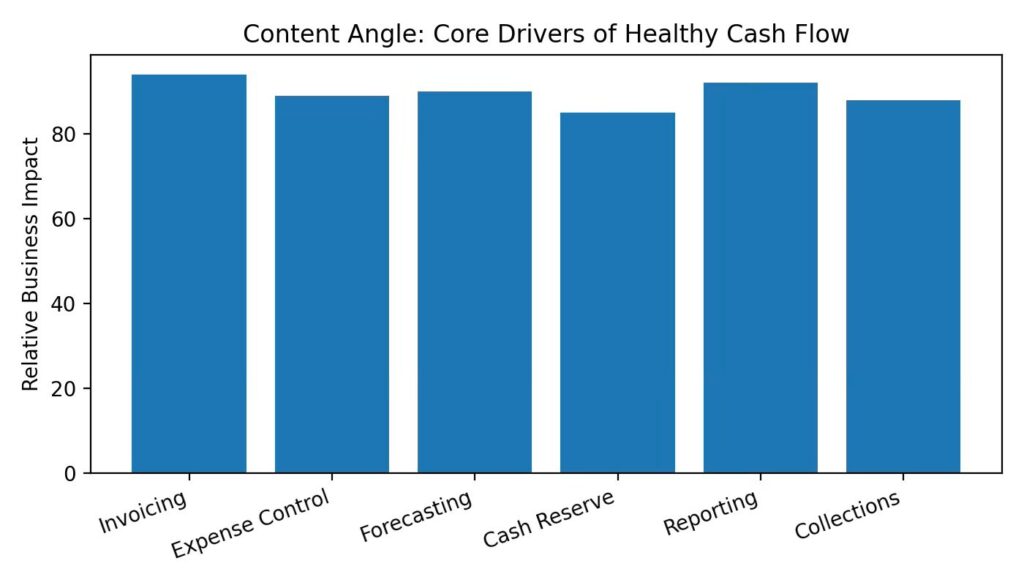
From all this, we conclude that timely invoicing, disciplined expense management, accurate reporting, forecasting, collections, and emergency reserves are some of the means of ensuring the financial stability of the company.
Digging Deeper
Smooth Out the Billing Process
On a regular basis, send the invoices faster, negotiate solid terms, then start sending payment reminders automatically for people to be reminded about the credits or reduce the outstanding payments.
Activity: Have a monthly financial review. Compare actual to project cash flows and make adjustments following the changing business conditions.
Monitoring of Expenses
It helps to look at regular expenditures each month, as you may have noticed some “monthly” black holes; for example: as a business, you might have too many subscriptions, too large vendor contracts, or even opt to spend that much money on operations-but the quality of services remains the same.
Activity: Have a monthly financial review. Compare actual to project cash flows and make adjustments following the changing business conditions.
Forecasting Cash Flow
Analyze the various controls you have put in place to reduce the possibilities of money being lost.
Action step: Organize monthly financial review, equate the plan for cash flow with the actual results, and adjust the spending model as per the existing business conditions.
The control function will come in as soon as money starts to disappear, but it may be too late by then to be able to curtail the flow.
Monthly Cash Flow Statements
These monthly statements are used, along with all other financial information, to plan hiring, inventory purchases, equipment upgrades, and other growth actions.
Action step: Organize monthly financial review, equate the plan for cash flow with the actual results, and adjust the spending model as per the existing business conditions.
Checklist for Managing Cash Flow
- issue customer invoices immediately.
- monitor receivables weekly
- monthly reconciliation of bank accounts
- study cash flow statements
- create an emergency cache
- forecast future cash needs
- control discretionary spending
- meet with the bookkeeper each month.
Suggested Internal Links
Authority Sources
- https://www.irs.gov/businesses/small-businesses-self-employed
- https://quickbooks.intuit.com
- https://www.sba.gov
FAQ
Is cash flow more important than profit?
A profitable business can still flounder if it doesn’t have enough cash on hand to be able to pay for each day’s expenses.
How often should I review cash flow?
An individual should review his cash flows at least monthly, or more than this because, if your business income varies, rapid growth is definitely in place.
Does bookkeeping help cash flow?
Oh, it does! Good bookkeeping provides fast access to pertinent financial data, thus helping budgets, forecasts, and collection rates.
Call to Action
Maikai Bookkeeping Services ingeniously, in fact, in order to enable small businesses to manage cash flow more efficiently, offers impeccable accuracy in bookkeeping, authentic and timely financial reports, and practical advice, contact our team today to build a stronger base for financial foundations.