
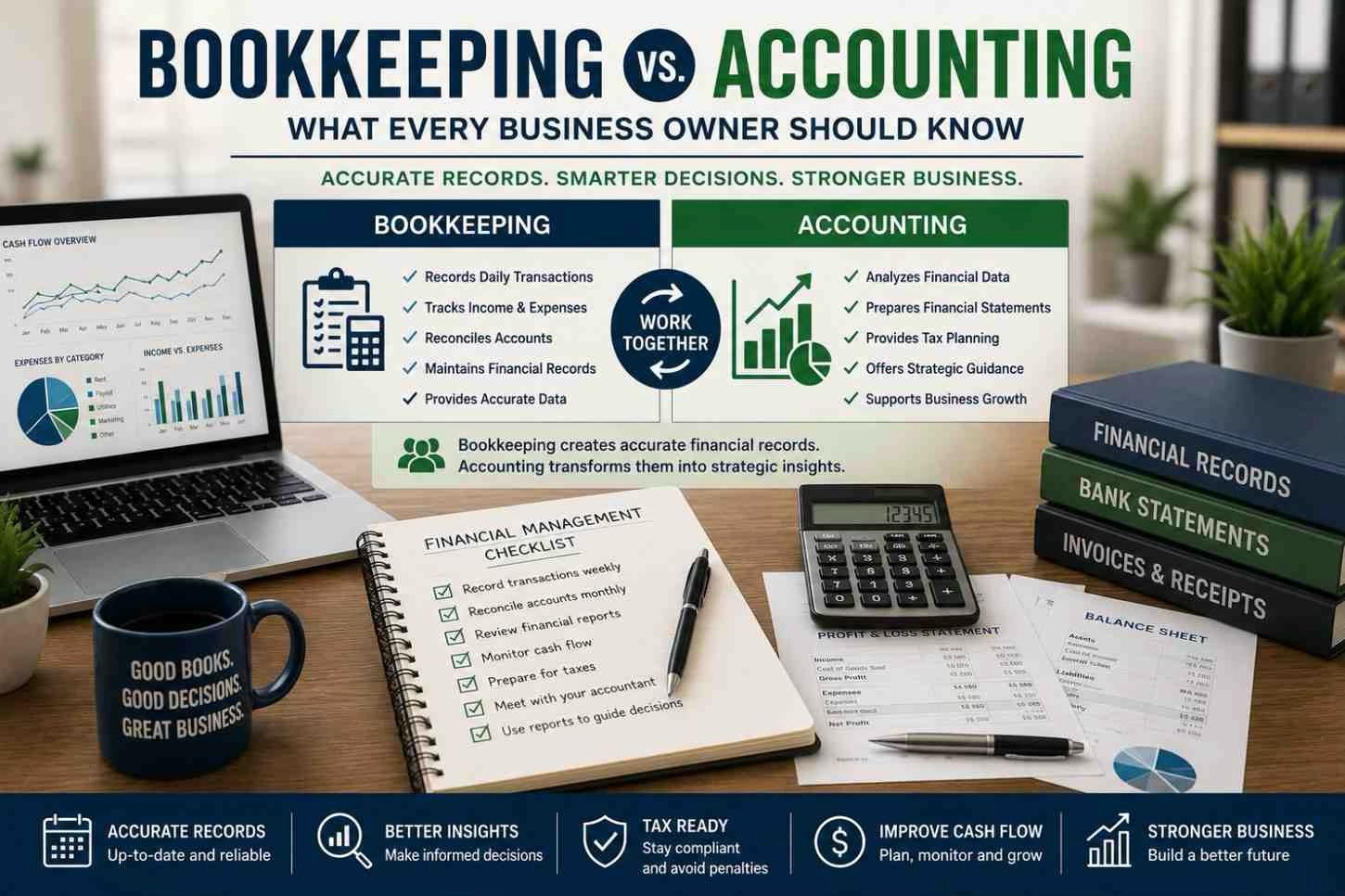

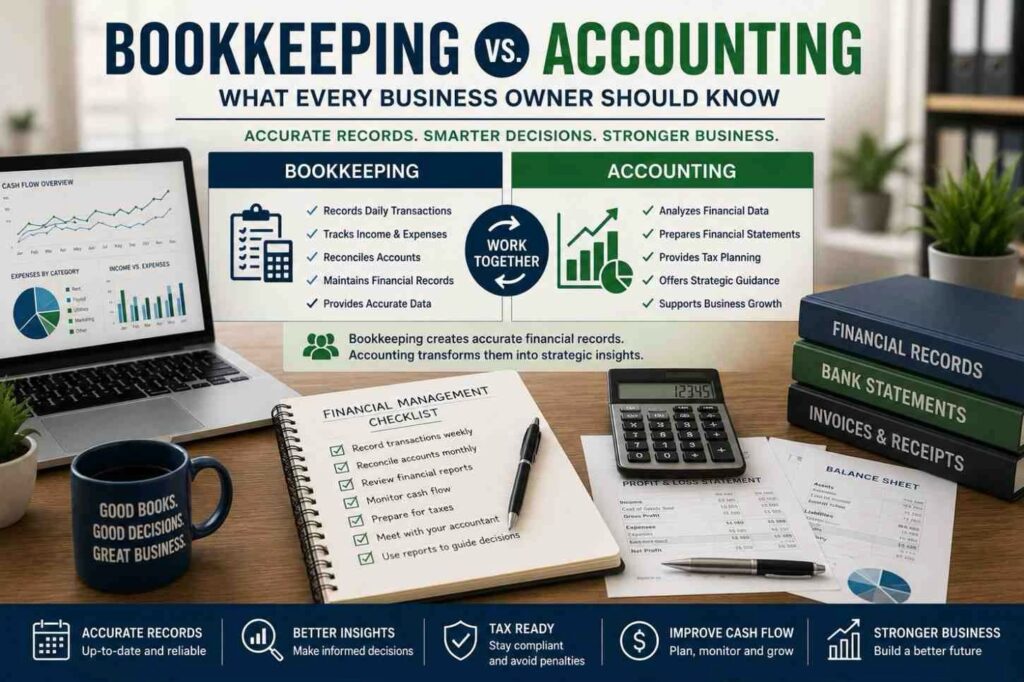
Bookkeeping vs. Accounting: What Every Business Owner Should Know
Introduction
Bookkeeping and accounting are fairly intertwined but aren’t necessarily the same thing when it comes to looking after a business.
The working described also help the owner of the business to keep a compliant record, which then paves the way for well-informed financial decisions.
From a well-organized bookkeeping standpoint the good foundation is laid for strong accounting.
Qualitative information: Working together, bookkeeping and accountancy add greater value to financial management.
What Is Bookkeeping?
All businesses keep books every day where they write down daily records of financial transactions, consolidate their monetary inputs as well as outflows, systematically file all records, and put their accounts in order.
Proper book-keeping will always ensure that your financial information in date, trend and accuracy levels align, at any time.
Its next step is for building a platform for financial reporting and tax preparation.
Qualitative information: Working together, bookkeeping and accountancy outperform stand-alone financial management.
What is Accounting?
Financial management aims at interpreting the financial information for strategic decisions.
Accounting helps produce financial reports, analyzes trends, assures that taxes are handled correctly, and helps set and maintain financial objectives.
Good bookkeeping gives you a foundation to make useful interpretations.
Real World Example: The greatest results are acquired by well-integrated bookkeeping and accounting in one big financial management mission.
Basic Differences
Bookkeeping actually protects events while accounting analyses and interprets them.
Bookkeeping, however, is systematic during most affairs through the beginning parts of the new month while accounting usually deliberates an assertion for reporting, budgeting, and tax purposes.
Both functions are very important when it comes to achieving any long-term objectives.
Real World Example: The greatest results are acquired by well-integrated bookkeeping and accounting in one big financial management mission.
Content Angle: Understanding the Difference
The comparison below shows how bookkeeping and accounting complement each other throughout the financial management process.
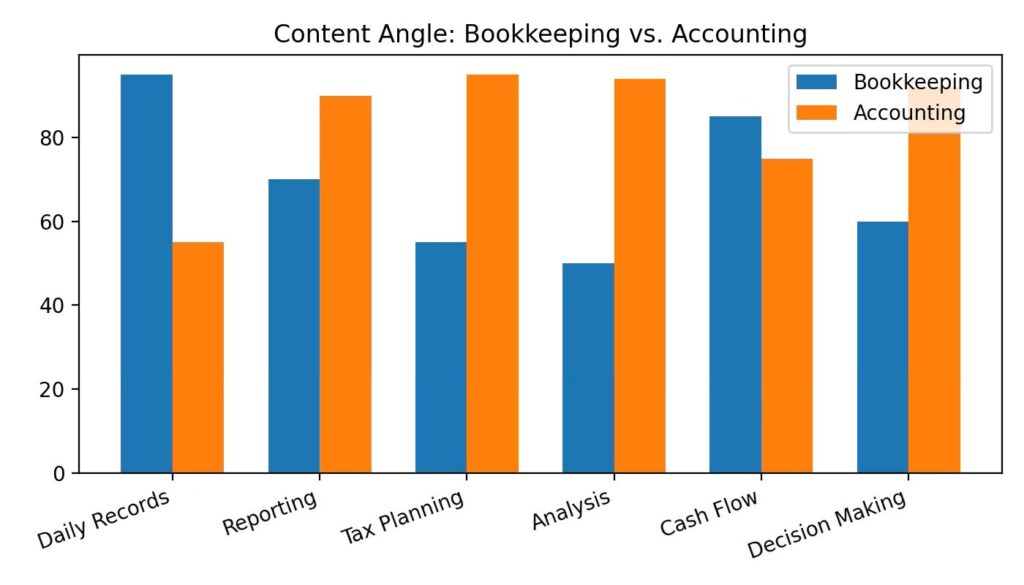
Editorial Summary: BOok-keeping keeps accurate financial records, while accounting turns those records into strategic insights for business.
Expansion In Sight:
“Cash Flow Management”
Very timely bookkeeping gives corporation owners a good overview of available funds, while accounting assists to forecast the availability of cash and profitability in the future.
STEP: At least once per month, take a look at your financial reports and make time to catch up with your CPA to discuss performance and future financial goals.
“Tax Preparation”
Clean records may provide a variety of benefits, such as simplified processes, reduced errors, and supporting legitimate deductions before their deadlines.
STEP: At least once per month, take a look at your financial reports and make time to catch up with your CPA to discuss performance and future financial goals.
“Financial Planning”:
The accounting divides economic data from accurate book-keeping in several groups to build business budgets, forecasts, pricing decisions, and expansions.
Taking an action: in this way, every month, frequently review financial reports and meeting with an accountant always is very good on the performance and upcoming financial goals.
Transact knowledge with professionals
Through their outlets and co-operations, an entrepreneur may concern themselves with overseeing financial administration in the operation.
Action step: Review financial reports monthly and visit your accounting professional as often as possible in order to review past results achieved and appraise future financial goals.
Financial Control Checklist
- Record transactions weekly
- Reconcile bank account statements each month
- Study your profit and loss analysis
- Keep track of your cash flow
- Be prepared for taxes year-round
- Maintain collected documentation.
- Meet with the accountant quarterly
- Make sure to use financial reports in making decisions.
Suggested Internal Links
Authority Sources
- https://www.irs.gov/businesses/small-businesses-self-employed
- https://quickbooks.intuit.com
- https://www.sba.gov
FAQ
Are accounting and bookkeeping different?
Yes, accounting uses bookkeeping data to come up with a basis for better financial decision-making.
Can bookkeeper serve as an accountant?
Nope. They have different roles, and even many businesses benefit from receiving both types of services.
How often should financial records be reviewed?
They need to be checked frequently, with reviewed performances and strategic planning conducted each month.
Action to be Done
Wondering if bookkeeping fits into your business? Then you need Maikai Bookkeeping Services to sustain an accurate accounting system useful to perform accounting services, tax preparation and business financial understanding. Contact us for a beeline approach to your financial management.